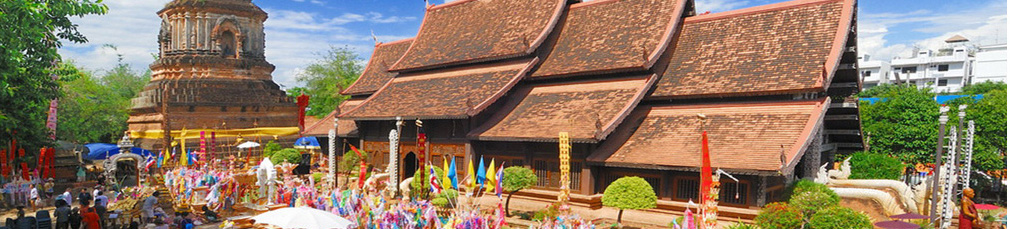
Wat Lok Molee, Chiang Mai
About the temple

Wat Lok Molee (วัดโลกโมฬี) stands on Manee Nopparat Road in Si Phum, just north of the moat around Chiang Mai's old city. It is one of the city's oldest temples, linked to the Mangrai kings who ruled the Lanna kingdom. After about 60 years as an abandoned ruin it became a working temple with resident monks again in 2001.
The temple is best known for its tall brick chedi from 1528 and its dark carved teak vihara, built after the revival in traditional Lanna style.
History in brief
- Around 1367 King Kue Na invites monks from Martaban (in today's Myanmar) to strengthen Buddhism in Lanna. A group of ten, led by the monk Ananda, is housed at Wat Lok Molee, so the temple already existed by then.
- 1527–1528 King Mueang Ket Klao gives the surrounding village land to the temple and builds the great chedi and a vihara.
- 1545 After the king is killed by his nobles, his ashes are placed at the temple. His daughter, Queen Chiraprapha, takes the throne and avoids a war with Ayutthaya by receiving its king with gifts and taking him to make merit at her father's stupa here.
- 1600s Under Burmese rule, Chiang Mai's rulers still treat the temple's senior monk with honour.
- 1897–1939 Records name the temple's abbots, and Prince Kaew Nawarat, the 9th ruler of Chiang Mai, restores it.
- About 1941–2001 No monks live here. Most of the land passes into private hands, leaving about 4 rai around the chedi.
- 2001 The abbot of Wat Phra That Doi Suthep leads a revival: a Songkran festival with 705 monks, one for each year of the city's age, then approval as a working temple on 9 October 2001.
- 2005 A new gilded spire and umbrella top are raised on the chedi in April.
What to see
- The great chedi: a castle-style brick stupa from 1528, with niches on all four sides and a stepped, bell-topped spire.
- The vihara: the main hall, built after 2001 in Lanna style, with layered roofs and richly carved wooden gables and pillars.
- The main Buddha image: a seated meditating Buddha named Phra Phuttha Santi Chira Boromma Loknat, cast for the new vihara.
- Queen Chiraprapha's pavilion: a small shrine with a statue of the queen who once supported the temple.
- The gate and monks' quarters: a stucco Lanna gateway facing the road, and residences built in local style.
Festivals and activities
- Songkran (Pi Mai Mueang), April: the northern Thai New Year, celebrated at the temple every year.
- Summer novice ordination, March–April: boys spend the school holidays as novice monks.
- Meditation retreats: a yearly retreat where lay people stay at the temple in white.
- Yi Peng, November: the full-moon festival, with the long Tang Tham Luang sermon reading.
- Buddhist holy days: Visakha Bucha, Makha Bucha, Asalha Bucha and the start and end of Buddhist Lent.
Groups based at the temple
- A centre supporting novice monks in Chiang Mai province
- A Pali language study centre for the northern monastic region
- A centre promoting moral education
- The Friends of Lanna Craftsmen Foundation, with a small museum of local craft knowledge
Visiting
The temple is on Manee Nopparat Road, a short walk north of the Chang Phueak area of the old city moat. Dress respectfully: shoulders and knees covered, and shoes off inside the vihara.